This is mind-blowing and I already knew a little something about it.
The top 0.1 percent (that is to say 1/1000 of Americans), composed of 160,000 families with average wealth of $72.8 million, owned 22 percent of the nation’s wealth — in 2015 numbers and it’s gone up dramatically since. Just sit with that for a moment.
By comparison, the bottom 90 percent — 144 million families with average wealth of $84,000 — owned only 22.8 percent of the wealth.
The 0.01 percent (or 1/10,000 of Americans) — a tiny group of people — 16,000 Americans hold as much wealth as 80 percent of the nation’s population — some 256,000,000 people — and as much as 75 percent of the entire world’s population.
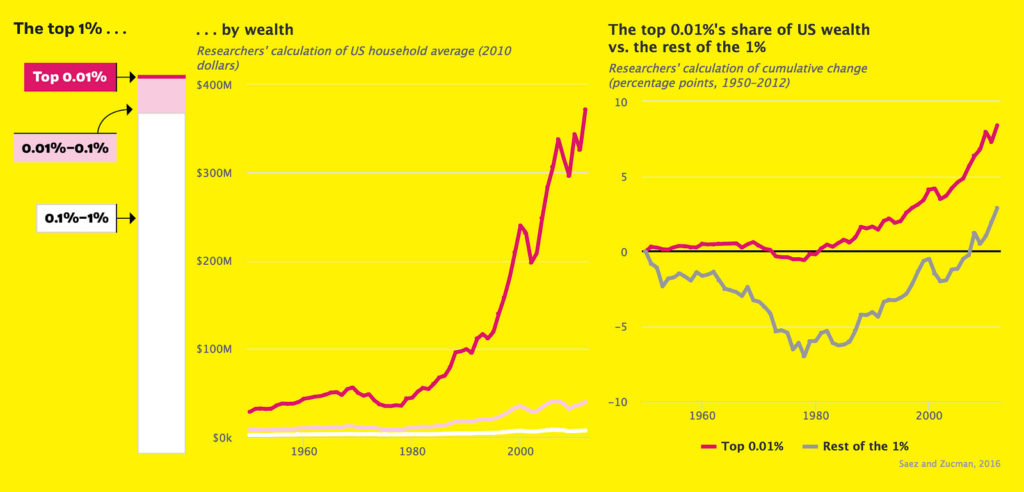
The deck is stacked so heavily toward the 0.1% or even the 0.01% (who are an order of magnitude richer) that most people in the top 10% aren’t even that much wealthier than the median income.
I knew graphed income disparity was a hockey stick, but no. It is basically a nearly flat line along the bottom of the graph that takes a severe upward turn at the very extreme right edge. Less a hockey stick than a capital L fallen over helplessly on its back.
Just for illustration, the U.S. could offer completely free tuition at all public institutions with a mere 0.5% tax on the top 0.01 percent — one half of one percent of their annual income. (Or we could just muddle along with our current student loan debt crippling future generations — $1.3 trillion and rising.)
If you are thinking you don’t support redistributing the wealth of the super-rich because you hope to be rich some day, you are fooling yourself. Or more precisely, the 0.1% are fooling you into believing you may be allowed to join the club.
If you are not working to redistribute the wealth of the rich, you are both collaborating with your oppressors and working against your class interests. In practical terms, this means supporting locally, regionally, and nationally things like rent control, student debt forgiveness, subsidized child-care, universal health care, unemployment insurance, and social security.
References:
University of Chicago Booth School of Business — Never mind the 1 percent
Let’s talk about the 0.01 percent http://review.chicagobooth.edu/economics/2017/article/never-mind-1-percent-lets-talk-about-001-percent
Slate — Exactly How Much Would It Cost to Make Public Colleges Tuition-Free? (An Update.) https://slate.com/business/2015/01/free-college-here-s-how-much-public-college-students-pay-in-tuition.html
American Prospect — How to Redistribute Wealth — Without the Guillotine http://prospect.org/article/how-redistribute-wealth%E2%80%94without-guillotine
Forbes —What You Don’t Know About The Top One Percent https://www.forbes.com/sites/michaeldurkheimer/2018/03/01/0-001-percent-one-percent/#4f1d2d502cf2
Originally published on Medium, November 18, 2018.